
 News
News
DIGHT-Net workshop report: Community and Digital Cultural Heritage – Interacting with the Digital Archive
November 26, 2025
The fourth online workshop of the New Trends in Digital Culture Studies, titled “Community and Digital Cultural Heritage: Interacting with the Digital Archive,” was held on Friday, 21 November 2025. The event brought together more than 20 participants from various parts of Europe.
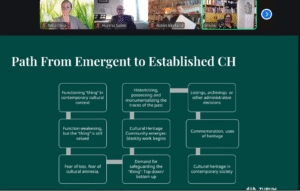 Professor Anna Sivula (University of Turku) delivered a lecture titled Digital Heritage Communities. Sivula has extensive experience in studying heritage communities, particularly those related to industrial heritage and computing cultures. One of the examples she discussed was the formation of the Demoscene heritage community in Finland, a creative computing and computer art subculture.
In her lecture, Sivula emphasised that cultural heritage communities are predominantly inclusive, bottom-up initiatives that safeguard places of memory, reinforce a sense of historical togetherness, and foster feelings of belonging. These communities operate within the domains of shared histories, as well as tangible, intangible, and digital traces of the past, alongside the experiences of their participants.
Sivula identified a trajectory for the formation of a digital cultural heritage community: such communities tend to emerge when a group becomes aware of the potential loss of something valued from the past and begins to fear that it may disappear entirely. According to Sivula, digital cultural heritage communities can be categorised into two main types: 1) online cultural heritage communities that exist on the internet but are not specifically focused on digitality, and 2) communities that attribute particular significance to digitality itself.
Associate Professor and Senior Lecturer Robin Ekelund (Malmö University) continued the workshop with a presentation titled “Memory Practices in and Beyond Retrospective Facebook Groups.” His research focuses on the digital memory practices of social media groups. Ekelund has identified three types of retrospective Facebook groups: those centred on a particular decade, those oriented towards a specific place, and those devoted to broader themes, such as The History of Sweden. He discussed his netnographic studies of social media groups and a project in which he examines the practices and meanings articulated by active members of Facebook’s digital memory groups.
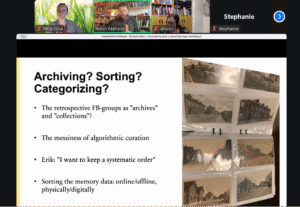 Ekelund highlighted how the platform’s algorithms prioritise instant memories and encourage rapid publication of memory posts in pursuit of likes and recognition. This dynamic, he argued, makes it difficult to construct coherent narratives or arguments, or to develop genuine connectivity within the community. His focus on social media platforms initially made him pessimistic about their capacity to foster constructive memory communities, a view that resonates with discussions of post-digital disenchantment and the ways in which social media memory groups can result in “sharing without sharing” and “greying memories.”
However, Ekelund’s perspective shifted as he turned to examine hybrid memory—the interplay between the digital sphere and the lived experiences of individuals active in these groups—through interviews with key contributors. This study demonstrated how people use social media to share, systematise, and make sense of the past, and how these groups become meaningful communities for their participants.
The panel discussion that followed the two presentations addressed the messiness of digital cultural heritage, a theme raised by both speakers. For example, outdated digital formats—whose continued accessibility depends on constant updating—introduce forms of disorder into cultural heritage materials. At the same time, social media platforms, which display content according to popularity metrics, can easily disrupt the organisational structures created by group members, making it difficult to relocate posts one has previously encountered.
The discussion also examined the role of institutions in supporting and shaping these communities, noting that some archives and museums have begun to take active roles on social media. Additionally, we reflected on the differing temporalities and life-cycles of digital cultural heritage groups operating online.
Watch the full recording of this event on our YouTube channel.